
Streamlining Campus Operations with PACDock
Colleges and universities manage thousands of assets spread across classrooms, laboratories, libraries, and hostels. Minimising loss and keeping equipment in working order is a daily challenge — especially across large, distributed campuses.
PACDock enables educational institutions to organise and monitor physical assets — from lab microscopes to computer systems — through structured tracking, service management, and reporting.
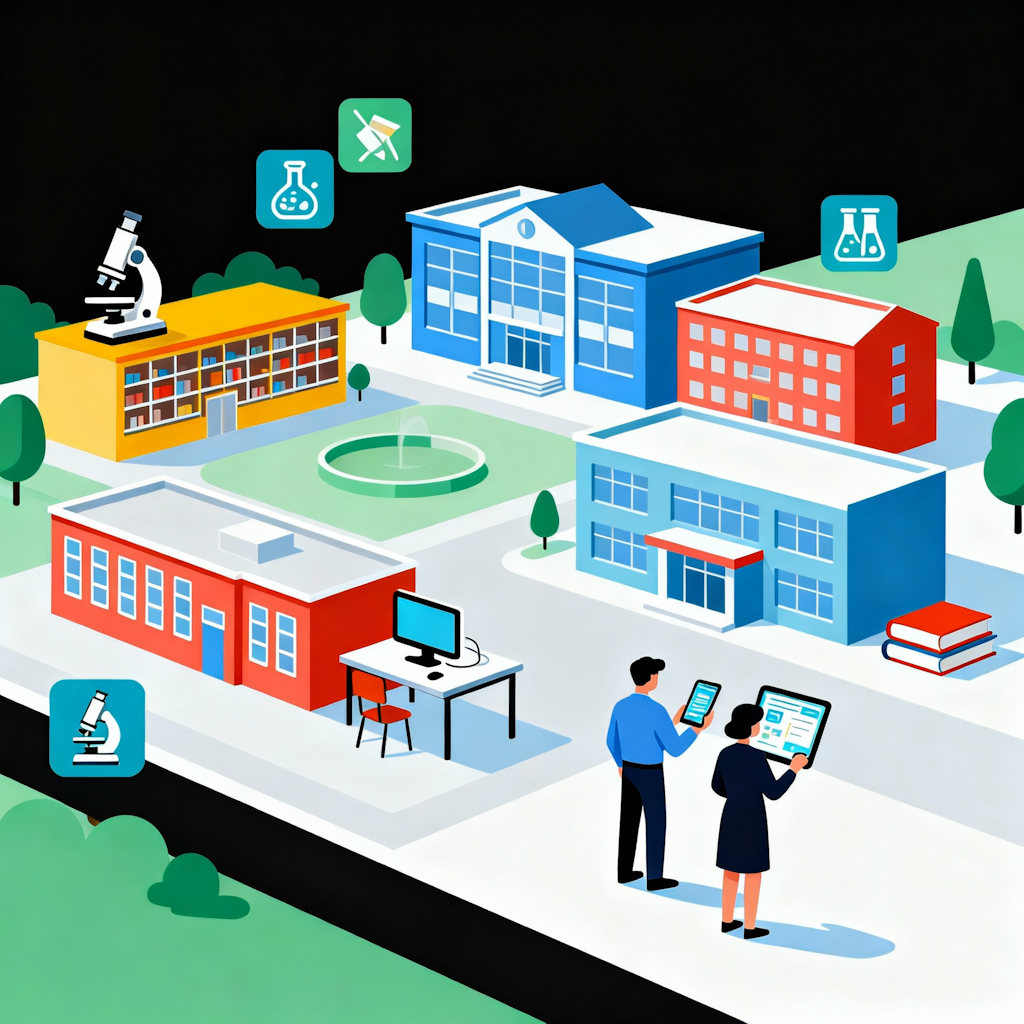
Centralised Campus Asset Visibility
Gain a unified view of all assets across departments and buildings.
- Categorise assets by department, building, or campus zone.
- Assign each asset to faculty, staff, or student custodians.
- Track where assets are located, who is using them, and their operational status.
- Manage both departmental inventory (lab instruments) and shared resources (laptops, cameras).
With complete transparency, institutions can plan budgets, avoid duplication, and reduce asset misplacement across campuses.
Room and Lab Equipment Tracking
Every classroom, lab, and hostel room can be configured as a kit — a collection of assets that together define that space's setup.
- Define kits such as Physics Lab Equipment, Multimedia Classroom, or Hostel Room Set.
- Track every item — desks, projectors, instruments, fans, or TVs — within that kit.
- Perform audits at the kit level to simplify verification during semester breaks or maintenance cycles.
This structure enables quick accountability and simplified maintenance across large facilities.
Faculty and Student Checkouts
Educational institutions regularly issue equipment to students and staff — laptops, lab kits, cameras, or recording devices. PACDock provides a seamless request → reservation → checkout → check-in workflow.
- Faculty or students request an asset or kit model for specific dates.
- Administrators approve and reserve available items.
- Items are checked out on issue and checked in upon return.
- Late returns or damage can be flagged and tracked automatically.
This ensures efficient utilisation, clear accountability, and full visibility of every borrowed asset.
RFID, QR, and Barcode-Enabled Tracking
Simplify audits and equipment lookup with scanning technology.
- Each asset is tagged with a unique QR code, barcode, or RFID chip.
- Use mobile devices or handheld scanners to instantly identify an asset's details.
- Conduct fast, campus-wide audits without disrupting classes or labs.
- Track movement of mobile equipment between buildings in real time.
This dramatically reduces manual errors and administrative workload during semester-end audits.
Maintenance and Service Management
Keep campus equipment running smoothly with proactive service scheduling.
- Preventive schedules — Plan routine maintenance for air conditioners, lab equipment, and IT devices before breakdowns occur.
- Work orders — Assign maintenance tasks to internal technicians or external vendors, with custom checklists for each equipment type.
- Cost tracking — Log service costs and parts replaced against each asset.
- Total cost of ownership — Automatically calculate TCO per department or campus to inform procurement and replacement decisions.
- Inspection escalation — Flagged assets from inspections can be escalated directly into a work order.
This ensures no equipment goes unattended and that maintenance spending stays visible and transparent.
Inspections and Condition Audits
Perform regular inspections across labs, hostels, and shared facilities.
- Conduct pre-semester and post-semester audits to assess equipment condition.
- Flag missing, broken, or outdated assets for follow-up.
- Maintain digital inspection records for compliance or accreditation requirements.
Audits ensure that every facility is ready for students — and that no valuable asset goes unnoticed.
Capacity Planning and Utilisation Analytics
Plan smarter with real-time data on how your assets and spaces are being used.
- Identify underutilised classrooms, labs, or equipment.
- Reallocate unused assets between departments rather than procuring new ones.
- Track depreciation, replacements, and lifecycle stages via visual dashboards.
This leads to more efficient procurement and smarter infrastructure spending across campuses.
Secure and Role-Based Access
Manage users based on campus roles with appropriate levels of access.
- Administrators, department heads, lab assistants, and maintenance staff each get role-appropriate access.
- Every action — assignment, service, inspection — is logged for full accountability.
- Support for multi-campus environments with both independent and centralised control.
Why Educational Institutions Choose PACDock
- Centralised visibility across departments, buildings, and campuses.
- Kit-based room and lab tracking with kit-level audit workflows.
- Structured faculty and student checkout with approval workflows.
- Preventive maintenance scheduling and work order management.
- Digital inspection records for accreditation and compliance.
- Utilisation analytics to reduce waste and optimise procurement.
Conclusion
From classrooms to research laboratories, PACDock helps colleges and universities manage their infrastructure more effectively — reducing asset loss, extending equipment life, and freeing up administrative time that would otherwise be spent on manual tracking.
With structured service management, RFID-enabled audits, and role-based access, institutions can focus less on chasing assets — and more on delivering quality education.
Ready to transform your asset management?
Get in touch with us today and book a demo to see how PACDock can streamline your operations and unlock new levels of efficiency.